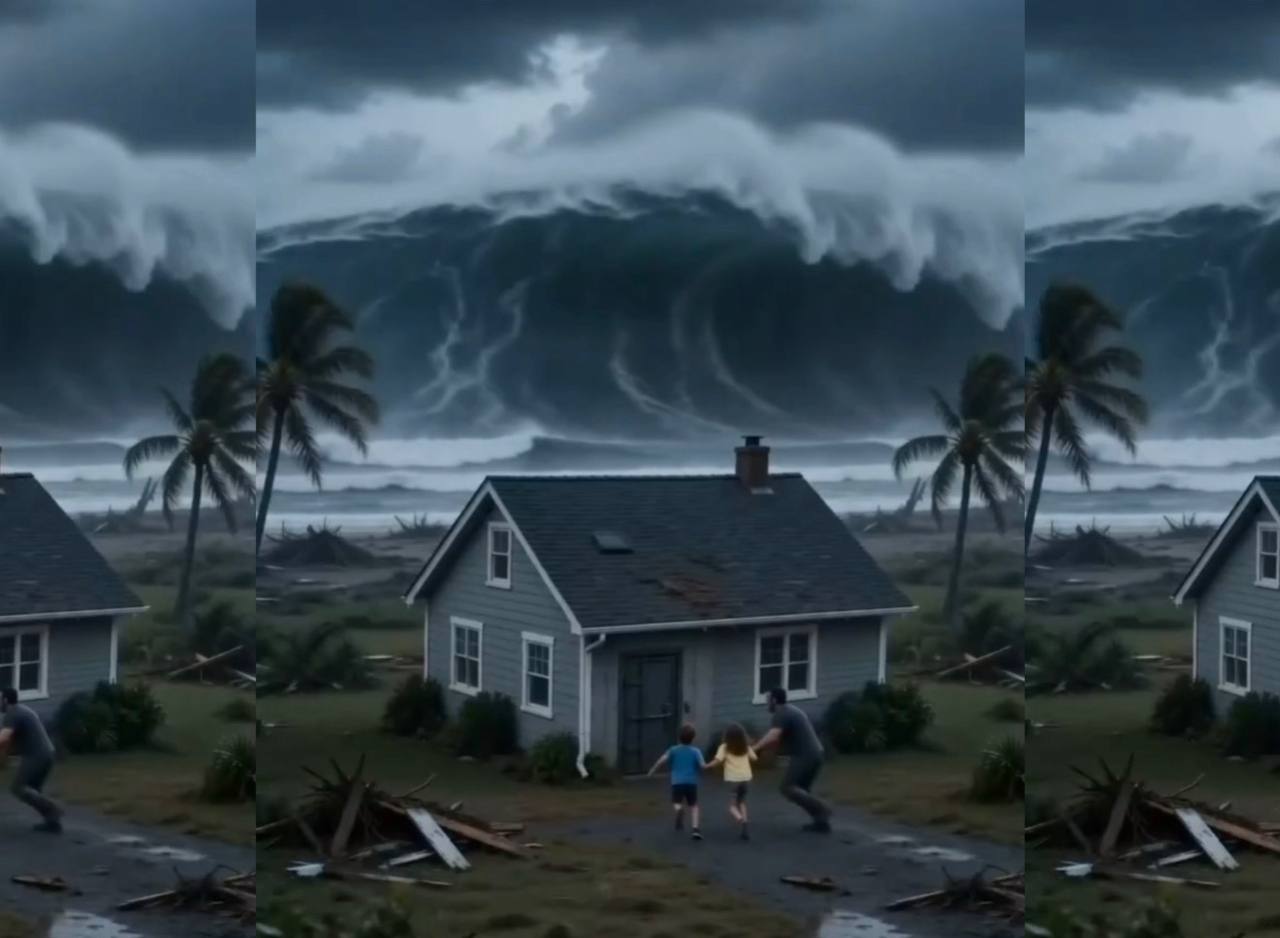
The Marchetti house sat two hundred feet from the water, perched on a low coastal rise that gave the family a little more elevation than the neighboring properties. Close enough that Dana could hear the tide changing from her kitchen window, but high enough that ordinary storm surge had never reached the foundation. She’d grown up loving that sound. Ten years of marriage to Tom, two kids, and she still couldn’t imagine living anywhere else.
It was a Saturday morning in late September. Tom was fixing the gutter. Mia, eight, was drawing chalk animals on the driveway. Jake, ten, was throwing a tennis ball against the side of the garage, the same rhythmic thud he’d been making for twenty minutes straight.
Dana noticed it first. Not a sound — an absence of one. The gulls had gone quiet. She stepped onto the porch and looked toward the water, and something about it seemed wrong before she could name why.
The tide had pulled back.
Not gradually, the way it did when the tide was going out, but rapidly, exposing wet sand and rocks that were normally covered even at low tide. The waterline was retreating farther and farther toward the horizon.
“Tom,” she said. Her voice came out strange, too flat for what she was feeling.
He looked over from the ladder. “What?”
She pointed.
He followed her arm toward the shoreline. For a second he simply stared. Then his face changed in a way she’d never seen before.
He was down off the ladder in one motion.
“Kids. Now. Inside — no, the bunker. Go.”
Mia looked up from her chalk, confused, a blue piece still in her hand. “What’s wrong?”
“Now, Mia.”
Tom’s voice cracked on the word.
Jake dropped the tennis ball and grabbed his sister’s hand without being told twice, some instinct kicking in that bypassed the need to understand.
They ran.
Dana would remember later how her body moved before her mind caught up — legs pumping, lungs burning, gravel biting through her sandals. The bunker was thirty yards uphill from the house, built into the rise behind the toolshed. Tom had installed it years ago after researching the property’s elevation and local flood maps, and she’d always thought of it as overcautious, maybe even a little embarrassing.
It wasn’t a doomsday shelter. It was a reinforced concrete emergency shelter, set above the home’s foundation and designed to withstand flooding, wind, and falling debris. Tom had stocked it with water, blankets, flashlights, a first-aid kit, batteries, and enough emergency supplies for the family to stay inside for several hours.
Behind them, the ocean had started to make a sound.
Not a roar yet — a deep, distant rumble mixed with the hiss of water moving over exposed rocks.
Tom looked back.
The retreat had stopped.
Far out beyond the exposed shoreline, the surface of the water seemed to be changing.
“Run,” he said.
Then louder:
“Run!”
It wasn’t direction anymore. It was just noise pushed out of him by fear.
Mia stumbled on the uneven ground and Jake yanked her up without breaking stride. Dana reached the bunker first, pulled the heavy door open, and half-shoved, half-caught her children as they came through it, tumbling into the dark, cool space inside.
She spun back toward Tom.
He was still coming.
Behind him, the horizon had changed.
The water wasn’t a single towering wall. It was a broad, fast-moving surge spreading across the shoreline, gray-brown with sand, branches, pieces of fencing, and other debris being carried inland. It was difficult to judge its height from a distance, but its speed was unmistakable.
The sound had become a roar now, physical, pressing against her eardrums.
“Tom!”
He hit the bunker entrance at a dead sprint.
Dana grabbed his shirt and hauled him the rest of the way through. Both his feet cleared the threshold. He turned in the same motion, grabbed the interior handle, and pulled the heavy door inward.
For one terrible second it seemed to resist him.
Water and debris were already moving across the lower ground outside, and the pressure against the structure made the door difficult to move. Tom braced one foot against the concrete threshold and pulled with both hands.
The door swung shut.
He dropped the locking bar into place.
The surge reached the property seconds later.
The sound was nothing like Dana expected.
Not a single cinematic crash, but a prolonged, grinding impact — water, debris, and structures being torn apart somewhere beyond the bunker walls. The ground itself seemed to shudder beneath them.
The bunker walls didn’t move, but everything in the air seemed to vibrate. Dust sifted down from the ceiling. The single emergency bulb flickered once, then steadied.
Mia was screaming, a high thin sound with no words in it.
Jake had wrapped both arms around her, his own face white and rigid, saying nothing.
“We’re okay,” Dana said, pulling both children against her, though she had no idea if that was true. “We’re okay. We’re okay.”
Tom stood with his back against the door, palms flat on the steel, breathing in ragged pulls.
Outside — muffled, distant, but unmistakable — came the sounds of the property being torn apart.
A groan of wood.
A crack that might have been the porch beam.
Something heavy scraping across what used to be their driveway.
Then came the sound of water rushing past the bunker, followed by a deep, low vibration as debris struck the outer walls.
They stayed like that.
Dana lost track of time. Five minutes, twenty, she couldn’t have said.
The children’s crying wore down into exhausted hiccups. Tom eventually slid down to sit against the wall, his hands shaking on his knees.
Every few minutes another surge of water moved past outside.
The sounds changed slowly.
The violent rushing became intermittent surges. Then came dripping, distant creaking, and the occasional heavy impact of debris settling somewhere beyond the walls.
But Tom didn’t relax.
“Don’t assume it’s over,” he said quietly.
Dana looked at him.
“Tsunamis come in waves. The first one isn’t necessarily the biggest.”
They waited.
Minutes passed.
Then more.
Eventually the movement outside became less violent. The bulb steadied. Dust stopped falling.
“I think we’re through the worst of it,” Tom said quietly.
Dana let herself breathe for what felt like the first time in an hour.
She kissed the top of Mia’s head, then Jake’s.
For a moment — just a moment — there was something close to relief in the small concrete room.
They were alive.
The house was probably gone. She could feel that truth settling somewhere inside her.
But they were alive.
Then she heard it.
A scrape.
Metal on metal, coming from outside the door.
Slow.
Deliberate.
Everyone in the room went still.
Jake’s head lifted.
Mia stopped crying entirely, some deeper animal fear replacing the smaller one.
The exterior handle moved slightly.
Then stopped.
It moved again.
Someone was testing it.
Tom pushed himself up off the floor and stared at the door.
His hand found Dana’s shoulder and gripped it hard.
Dana looked at him.
“Who might it be?” she whispered.
Tom didn’t answer.
He was listening.
Outside, a man’s voice came through the thick door, muffled almost beyond recognition.
“Hello? Is — is someone in there?”
A pause.
“I saw the door. Please, if anyone’s in there—”
The voice was hoarse and exhausted, as though the man had been shouting for a long time.
Tom’s expression tightened.
“Ray?” Dana whispered.
He looked at her.
“From the Hendersons’ place. Two houses down.”
She was already taking a step toward the door.
“Tom, that’s Ray.”
“We don’t know that.”
“I know his voice.”
Outside, the man spoke again, weaker this time.
“My wife — I don’t know where my wife is. The water took me. I don’t know how far. I woke up against your wall.”
Dana’s stomach tightened.
“I think I broke something. I can’t feel my arm right.”
Jake had gone very still against Dana’s side, listening.
Mia’s small hand found Dana’s sleeve and gripped it.
“If that’s Ray,” Tom said quietly, “he may not be the only person still out there.”
He looked toward the door.
“We don’t know if the water is still moving. And there could be another surge.”
“Then we wait until it’s safe.”
Tom nodded.
They waited another several minutes.
Then he moved to the small reinforced observation window set into the door — a four-inch square of thick glass near eye level. Dana had forgotten it was even there.
Tom wiped grime and moisture from the inside with his sleeve and pressed his face close to the glass.
The silence stretched.
Dana watched his shoulders, waiting for them to tell her something before his voice did.
“It’s Ray,” he said finally.
He looked again.
“He’s alone.”
Another pause.
“He’s sitting against the outside wall. His arm doesn’t look right.”
Tom kept watching for several seconds longer.
The ground immediately outside the bunker was covered in shallow, moving water, but there was no longer a fast current rushing past the entrance.
“I’m going to bring him in.”
He stepped back from the window.
“Dana, get the kids behind me.”
She pulled Jake and Mia toward the far wall.
Tom unlocked the door and opened it only a few inches first, watching the water outside.
Nothing rushed through.
He opened it farther.
Gray light spilled into the bunker, along with the smell of salt, wet earth, fuel, and something burnt underneath it.
Ray Henderson was slumped against the outside of the bunker wall exactly as Tom had described.
He was soaked through.
His left arm was held awkwardly against his chest.
A gash along his hairline was crusted with blood and sand.
Behind him, where the yard used to be, there was almost nothing recognizable — no fence, no shed, no toolshed, just flattened debris, scattered wreckage, and shallow standing water reflecting a sky that had gone the color of dishwater.
“Ray.”
Tom crouched beside him.
“Ray, can you hear me?”
Ray’s eyes found him, unfocused at first, then sharpened.
“Tom.”
A broken, relieved half-laugh escaped him.
“Thank God.”
His voice cracked apart entirely.
Tom carefully helped him up, supporting his injured side.
Dana came forward with the kids close behind her.
Together they got Ray through the doorway and into the bunker, out of the exposed area.
Mia pressed herself into the corner, watching the stranger-who-wasn’t-a-stranger with wide, wary eyes.
Jake, older and steadier, grabbed a folded blanket from the shelf without being asked and held it out.
Ray took it with his good hand.
“Thank you,” he whispered.
Tom closed and secured the door again.
Outside, water still moved slowly through the ruined neighborhood in irregular surges.
Somewhere in the distance, something collapsed with a long, hollow groan.
The five of them sat together in the gray light of the bunker, listening.
They didn’t know who else had survived.
They didn’t know whether Ray’s wife was alive.
They didn’t know what they would find when they finally emerged.
For now, all they could do was wait.