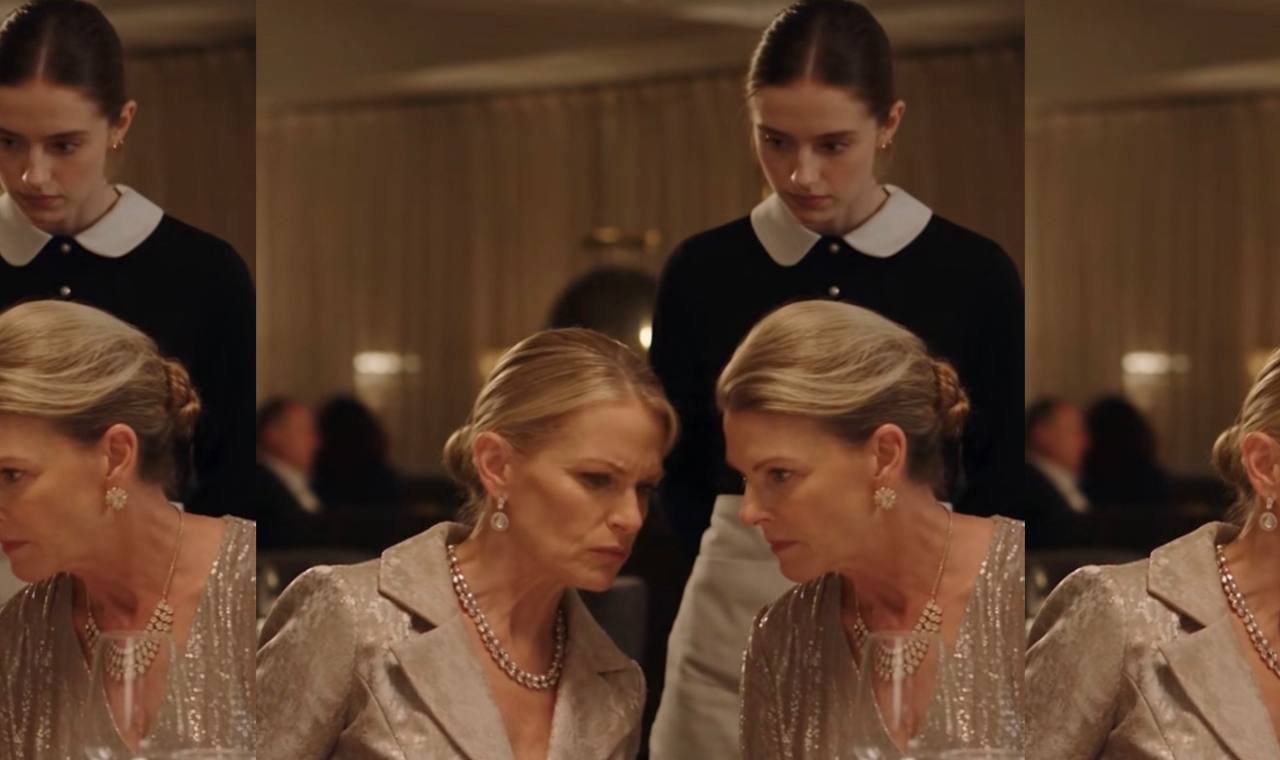
The strand of hair was about seven inches long, honey blonde with lighter highlights, and it had not been in the pasta when the plate left the kitchen.
Nora Brooks didn’t know that yet. At 7:42 on a Saturday night, standing beside Table Twelve at The Larkspur with a linen napkin folded over her forearm, all she knew was that a woman in a cream silk blouse was holding up a fork like evidence.
“There’s a hair in my food,” said Celeste Harrington. She didn’t say it loudly. She said it the way people say things they’ve rehearsed. “Get your manager. Now.”
Nora felt her stomach tighten, but her face stayed exactly where it was. Three years of Saturday nights had taught her that.
“I’m so sorry, Mrs. Harrington,” she said. “Let me take that back right away. I’ll have the kitchen remake it, and it will be off your check.”
“I don’t want another plate from a kitchen that does this,” Celeste said. “I said manager.”
To understand how the evening reached that point, you have to go back about forty minutes.
The Larkspur sat on a quiet street in Westport, Connecticut. It had sixty-two seats, white tablecloths, amber lighting, and a wall of wine that the regulars liked to point at when they had guests. Entrees ran from thirty-eight to seventy-two dollars. On weekends, the reservation book was full by Tuesday.
Nora worked the floor Thursday through Sunday. She was twenty-two, with dark hair pinned in a low knot, a black vest, and a brass name tag that said only Nora. She moved through the dining room the way good servers do, quickly but never looking rushed, and she remembered who wanted the bread warm and who wanted it left alone.
At 7:05, two women arrived for a reservation under Harrington. Celeste was in her late forties, with tasteful jewelry and the posture of someone who had spent years being careful about her posture. Her friend Diane Kessler was a few years older, softer around the edges, and already looked like she’d rather be somewhere quieter.
Celeste had requested the window table, Table Four. The couple sitting there had come early for an anniversary and were lingering over dessert.
“I can seat you at Twelve right now,” Nora explained, “or Table Four in about fifteen minutes. I’m happy to bring you something from the bar while you wait.”
“We requested that table,” Celeste said.
“You did, and I’m sorry about the wait. The party there is celebrating an anniversary and they’ve been a little slow.”
“Twelve is fine,” Diane said quickly.
Celeste let out a small breath through her nose, the kind meant to be heard, and followed Nora to the table.
It wasn’t a dramatic start. That’s what made it easy to miss. Celeste asked how long Nora had worked there, and Nora said three years, part-time.
“And what do you do the rest of the time? School?”
“I’m finishing a hospitality management degree in the spring.”
“How nice,” Celeste said, in a voice that meant how sweet. “I always say a little job like this is good for young people. Builds character. Until you find something real.”
Diane winced into her menu.
“Thank you,” Nora said pleasantly. “I’m enjoying it. Can I start you with something to drink?”
Over the next half hour, Celeste kept adding small things. She sent the wine back and then admitted it was fine. She looked at her watch when the appetizers took eleven minutes, because the kitchen was slammed and the burrata plates were being made one at a time. She told Diane, not quite quietly, that at these prices she expected someone “a bit more seasoned.”
Nora heard every word and answered none of it. She refilled the water, apologized for the wait once, and checked back exactly when she should have.
What she didn’t know was that Celeste’s night had been going badly long before she reached the restaurant.
Celeste Harrington had grown up in Youngstown, Ohio, where her father ran an appliance repair shop and her mother did the books. She remembered customers who never learned her father’s name and called him “the repair guy” while he stood in their kitchens. She had promised herself early that no one would ever look through her that way.
She married a developer named Greg, moved east, and spent twenty years learning the unwritten rules of a town where nobody wants to seem new to money. Somewhere along the way she learned one more thing: at certain restaurants, the word manager worked like a key. Say it with the right tone and dessert appeared, or a comped entree, or an apology. She’d never analyzed why it felt so good. It just did. For a few minutes, everyone rearranged themselves around her.
Tonight, her husband had canceled their anniversary reservation for the third time that month, and she had brought Diane instead. She was tired, embarrassed, and looking for somewhere to put it.
When the linguine arrived and was perfectly fine, she looked at the young waitress with the calm smile and the untroubled face, and something in her wanted to see that face change.
Diane saw it happen. She was reaching for her water when Celeste lifted her hand to her own head, winced slightly, and pulled one strand loose. Then she laid it across the top of the pasta, smoothed it once, and set down her napkin.
Diane opened her mouth. Nothing came out. She would regret that for a long time.
Daniel Brooks had been watching Table Twelve for twenty minutes.
He was fifty-eight, in a charcoal suit and open collar, with silver at his temples. He’d started at sixteen as a dishwasher in a Stamford diner. He worked his way up to line cook, then sous chef, and finally scraped together enough to open a thirty-seat place in 1999, when the bank made him bring a cosigner. He built The Larkspur one table at a time. He was known for two things: he never raised his voice, and he noticed everything.
He’d noticed the tone at Table Twelve before the complaint ever came. So when he saw Nora’s shoulders stiffen, he was already crossing the room.
Nora had agreed to work at The Larkspur on one condition, and it had been hers, not his. She wanted no special treatment. She had bused tables and worked the host stand before he let her carry plates. Staff called him Dan, and at work she called him Mr. Brooks. She had never once sat in his office during a shift. It wasn’t that she was embarrassed by him. She wanted to know what she was worth on her own.
The family could have paid for anything. He’d offered to cover her rent and tuition. She took the tuition, since he insisted, and paid everything else herself. She rented a room in Bridgeport with two roommates, drove a used Civic, and wanted to open a restaurant of her own someday. When she’d told him that, he hadn’t smiled or called it cute. He’d said, “Then learn every station before you tell me what you’d change.”
Now he walked up to Table Twelve, stopped half a step in front of his daughter, and spoke in the same even voice he used with everyone.
“I’m so sorry about this. I’m the owner. Let me take care of it personally.”
Nora closed her eyes for exactly one second.
“But, Daaad!”
It came out in that particular two-syllable groan that any daughter recognizes, half embarrassment and half exasperation. It meant: I had this. I did not need you.
Her cheeks went pink. A man at the next table glanced over, then politely looked away.
Celeste’s fork stopped halfway to the plate.
“Your… daughter?” she said.
“Yes, ma’am,” Dan said. “Nora’s been with us three years.”
Diane’s hand went to her mouth. Celeste’s face did something complicated. First it went blank, then pale, then a slow, mottled red. The whole night flashed past her: the “little job,” the “more seasoned,” the watch glance, the table she’d wanted, the strand of hair she’d pulled out herself, all of it aimed at a girl who was, at that exact moment, being told by her own father that she was being handled.
Nobody in the restaurant gasped. Real rooms don’t. Somewhere behind them, a cork came out of a bottle.
Dan glanced at his daughter, and the corner of his mouth moved.
“You’re right,” he said quietly. “It’s your table. Go ahead.”
He stepped back, not far, but enough. Nora took a slow breath and turned to face the women.
“May I look at the plate?”
Celeste pushed it an inch toward her. The hair lay across the top of the linguine, whole and straight, without a speck of sauce on it. Anything that had been tossed in a hot pan with garlic and butter would have come out coated. It was also honey blonde, and the two line cooks working that night were both men in caps.
Nora noticed all of it and said none of it. Accusing a customer was not her job. She simply stepped back.
Dan spoke instead, gently. “Mrs. Harrington, I’d like to ask one thing and I’d appreciate an honest answer. Did this come from our kitchen?”
“What are you implying?”
“Nothing. I’m asking.”
The pause stretched. Celeste looked at her plate, then at Diane, hoping for backup.
Diane looked at the tablecloth.
“Celeste,” she said quietly. “I saw you.”
“Diane.”
“I’m sorry. I should have said something before they had to come over.”
Celeste’s jaw worked. “It was one hair,” she said at last, and her voice was smaller than it had been all night.
“It was one hair,” Dan agreed. “And I’ll tell you why I care about it. Every complaint in this restaurant gets taken seriously, and that only works if the complaints are real. A false one goes on a server’s record. Three in a season means a review, and it puts a mark next to a name that has worked very hard. It costs my kitchen a night’s confidence. And it makes it a little harder for the next guest who really did find something.”
His tone was almost conversational. That was what made it land.
“The pasta is off your check,” he continued, “as it is for anyone who raises a concern. The rest I’ll ask you to settle. And I’d rather you didn’t book with us again.”
Celeste opened her mouth, then closed it.
“May I say something?” Nora asked.
Her father nodded.
She looked at Celeste directly, without heat. “When you told me there was a hair in your food, I offered you a new plate. I’d have done that for anyone, whether or not I knew the owner. That’s the job.” She paused. “You said earlier this was a little job before something real. It’s real to me. It’s the first thing I’ve built that nobody handed me. I’d have been fine tonight without my father stepping in. I’d just ask that you speak to whoever brings your food the way you’d want to be spoken to. That’s all.”
The table was silent.
“I’m sorry,” Diane said, and she meant it. “You were nothing but kind to us.”
“Thank you,” Nora said. “That means something.”
Celeste stared at her hands for a long moment. “I apologize,” she said finally. It was stiff and thin, but she said it.
“Thank you,” Dan said. “Another server will take care of your check.”
The two women left ten minutes later. Diane had driven herself. She hugged nobody, said very little, and pulled out of the parking lot alone.
Celeste walked past Table Ten on her way out. A woman there, someone from her club, met her eyes for half a second and then looked back at her wine. Nothing was said. Nothing needed to be. Westport is a small town in the ways that count.
There was no scandal and nothing went viral. But the following month, Diane’s calendar filled up with other lunches, and Celeste’s invitations arrived fewer and fewer times. She never told anyone the whole story, and she didn’t have to. Diane told two friends, and the two friends told a few more.
Late that night, driving home alone, Celeste thought about the appliance shop in Youngstown. She thought about her father standing in strangers’ kitchens while they talked over his head. She had spent twenty years making sure that no one would ever treat her that way. Somewhere along the line, without ever deciding to, she had become the customer she used to watch from the doorway.
Two weeks later, Nora was training a new server named Kayla, who was nervous and kept apologizing before anyone had asked her anything.
“What do I do if a customer’s really rude?” Kayla asked.
Nora thought about it. “You stay kind. You fix what you can fix, and you never take it personally. Most of the time it isn’t about you anyway.”
“And if they’re wrong?”
“Then you still treat them like a person,” Nora said. “You just let the facts speak for themselves.”
She straightened a fork on Table Twelve and glanced across the dining room, where her father was greeting a couple at the door.
Celeste had spent an entire evening trying to decide who Nora was by reading a name tag and a black vest. But a name tag is only what someone wears, and how you treat that person is what you are. That was the one thing Celeste hadn’t thought about, and she’d learned it in front of everyone who mattered to her. A hair is easy to pull out. What you can’t take back is the moment somebody else watches you do it.