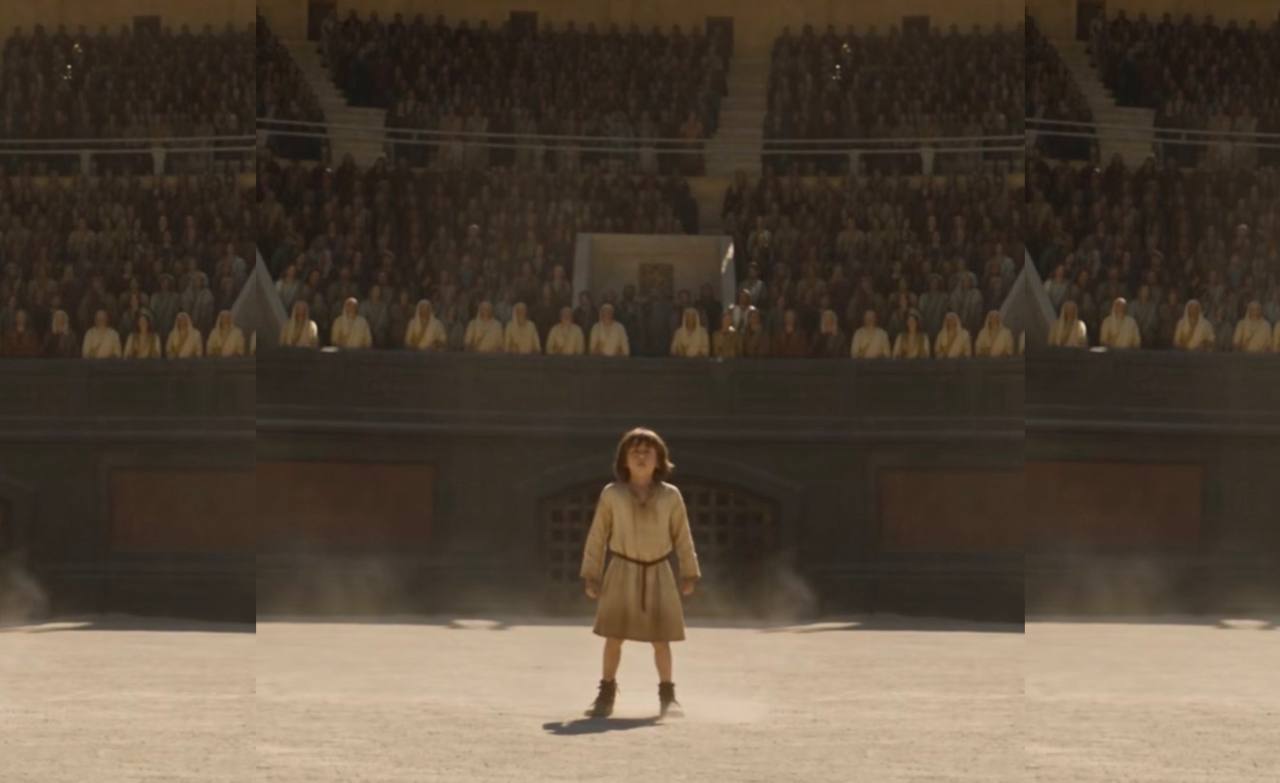
Tobin had counted the stones in the tunnel wall four times, and each time the number came out different, because his hands would not stop shaking.
Twenty-three. Twenty-four. Twenty-three again.
Above him, the crowd of Karst Arena made a sound like the sea heard from inside a shell: enormous, patient, hungry. He was ten years old. He had crossed the border hidden in a grain wagon, then in the shadow of the water-carriers, and his stomach had been a knot for all three days. In his fist he held a small whistle carved from river reed, its surface worn smooth by someone else’s thumb.
He was not brave. He wanted very badly to be sick, and to go home, and to be anywhere but here. But he had made a promise beside a bed last winter, and the promise did not care whether he was afraid.
“One word,” he whispered to the whistle. “I only need to reach him for one word.”
Then the horns sounded, and he crept toward the light.
Forty feet above the sand, on the balcony of Ostrel, King Edmar sat with his hands folded so tightly that his rings had begun to bite.
He was thirty-seven and looked fifty. Behind his chair stood Corvin, his adviser, white-bearded and silent, a man who had served two kings and learned that silence was the most useful thing a counselor could offer.
Across the arena, on a balcony hung with gold banners, sat the King of Valdor.
The two kingdoms had shared a river for a thousand years and had spent twenty of them pretending to be at peace. The Anwen was born in Valdor’s mountains and died in Ostrel’s fields, and whoever controlled its sluice gates controlled who ate. Twenty years ago that fact had become a war. It ended at Harrow Ford, where four thousand men died in a single afternoon and the water ran brown for a week.
The surviving kings had knelt at the Twin Stones on the border hill and sworn that armies would never meet again. In their place came the Reckoning. Every third autumn, each kingdom sent one champion into the sand at Karst, and the winner held the Anwen’s sluice gates for three years.
Valdor had won the last four Reckonings. Ostrel’s fields lay cracked and pale. Its bread was thin, and its children thinner. It had buried three champions in nine years, and no one else would volunteer.
Everyone knew why. Valdor’s champion was Garran, called the Unnamed.
Nobody could say where he had come from. Valdor’s old king had found him young and already enormous, and he had grown into a man near eight feet tall, with hands that could fold a shield like parchment. There were other things people said about him. Before any fight at Karst, tradition demanded the Naming: each fighter called out his mother’s name and his village, so that if he fell, the dead could be sent home with a name. Garran had never once answered. The heralds would ask, the arena would wait, and he would stand there in silence until they gave up. And after every fight, when the crowd had gone, he knelt beside the fallen and whispered something into the sand. Valdor’s soldiers said he was cursing the dead. Ostrel’s peasants said he was casting spells.
Some claimed he wore a scrap of river reed on a cord beneath his armor, and that a blacksmith who had tried to remove it had come away with a broken arm.
Edmar knew what the champion whispered. He had never told anyone how he knew, and he never looked at Garran’s face. Not once in eleven years.
Across the arena, King Roderic of Valdor watched the empty sand and felt entirely certain of himself.
He was not a cruel man, though Ostrel’s peasants would have argued the point. His father had died at Harrow Ford, and Roderic had grown up in a court where every lord still whispered that the Reckoning was a coward’s peace, that Valdor’s armies should march and finish what the dead had started. For eleven years he had silenced them with a single argument: Valdor never loses.
He had come to believe that peace and winning were the same thing. If the champion ever fell, he knew, the war lords would not wait a day. And a war between the kingdoms would not be a river dispute this time. It would be a burning.
He rose from his golden throne, and the crowd rose with him. He lifted one hand toward the giant iron gate below.
“Let the warrior who has never known defeat step into the light.”
The gate opened with a roar of metal that shook dust from the arena walls.
For a moment there was only darkness in the archway. Then came the footsteps, slow and heavy, each one a small thunder in the sand, and Garran walked out into the sun.
The crowd gasped. Even Valdor’s own people gasped, and they had seen him many times. His armor was black and battered, dented in a hundred places and mended in fifty. He stood a full head above the tallest guards at the gate. But it was his face that unsettled them, because it was so plainly a man’s face: broad, sun-hardened, crossed with old scars, and tired in a way that had nothing to do with fighting. It was the face of someone who had not slept properly in twenty years.
On the Ostrel balcony, Edmar looked at the sand instead. He leaned toward Corvin, his voice barely a breath.
“No man in my kingdom can stand against him… are we already doomed?”
“Not doomed, Majesty,” Corvin murmured. “Beaten. There is a difference, though a small one. If no champion answers, you forfeit the river.”
“Then we forfeit.”
“Then Ostrel starves by spring.”
Edmar closed his eyes. He had known this before he left home. He had come to Karst to lose gracefully and buy a little mercy, and he was learning how little mercy cost and how little it bought.
Below, the herald raised his staff. “Ostrel! Name your champion!”
Silence.
“Ostrel! Name your champion!”
Silence. The wind moved the dust in slow spirals across the sand.
“By the law of the Twin Stones, if the challenged crown has no champion, any subject of that realm may rise and give the Answer. Ostrel, does anyone answer?”
Edmar opened his mouth to say the words of forfeit.
A small figure came running out of a side entrance.
He was a thin boy in a water-carrier’s stained tunic, too big for him, and he ran as if the ground might vanish beneath him. Dust rose around his feet. He crossed half the arena before anyone understood what they were seeing, and the crowd’s noise died in a long, strange ripple until there was nothing left but the sound of his breathing.
He stopped in the center of the arena, ten paces from the giant. The giant looked down.
Tobin’s knees were shaking so badly that anyone could see it. His face was white. But he did not step back. He lifted his chin and shouted, and his voice cracked in the middle of it, and he finished anyway.
“If no one dares face him… then I will!”
High above, King Edmar rose so suddenly that his chair fell backward. The blood had left his face entirely.
“Impossible…” he whispered. “That boy is my son.”
Corvin caught his arm before he reached the balcony rail.
“Majesty. If you stop this now, Ostrel forfeits and the boy is dragged out. If you go down there, Valdor’s lords will call it an attempt to break the Answer, and every one of them wants a reason.”
“He is ten years old!”
“Yes. And he was locked in the east tower with his nurse three days ago. Someone should ask how he got out.”
Edmar did not answer. He stood gripping the rail, and for the first time in eleven years he looked directly at Garran.
Across the arena, King Roderic was frowning. A child. He had not expected this, and he did not like it. But the Answer, once spoken, could not be withdrawn without forfeit, and a hundred lords were watching. He nodded stiffly to the herald.
“The Naming,” the herald called, his voice unsteady. “Champion of Valdor, name your mother and your village.”
Garran said nothing, as always.
“Answering party of Ostrel. Name yourself.”
Tobin swallowed. His voice, when it came, was small, but the arena had gone so quiet that it carried to the highest seats.
“I am Tobin, son of Edmar, King of Ostrel.” He drew a breath. “And my mother was Maren of Wenhollow.”
The giant went completely still.
It was not a dramatic change. He did not step back or drop his sword. But something in the great scarred face came loose, the way a wall goes when one stone is pulled from the bottom.
“Wenhollow,” Garran said. It was the first word anyone in Karst had heard from him in eleven years. His voice was low and rough from disuse. “Wenhollow burned. No one lived.”
“One person did,” Tobin said. “She was six. Her brother pushed her under the ford-gate through the drain, and he could not fit after her.”
Very slowly, Garran’s hand rose to his throat. He pulled a cord out from beneath his armor. On it hung a small whistle of river reed, dark with age, with two notches cut into it.
Tobin held up his own. It had one notch.
“Your father carved one for each of you,” Tobin said, and now he was crying without seeming to notice. “Two for you, because you were older. One for her. She kept it for twenty years. She looked for you the whole time. She sent letters to every trader who crossed into Valdor, and nobody wrote back, because nobody knew who you were. She died this winter, and before she did, she made me promise to find you. She said to tell you…”
He faltered. Garran waited, and the whole arena waited with him.
“She said to tell you that she was never on the other side of the gate because she chose it.”
Nobody in the stands understood that sentence. Two men in the arena understood it completely.
Up on the balcony, Edmar stood with both hands over his mouth.
It had been the last hour of Harrow Ford. He had been seventeen, commanding the rearguard, with Valdor’s army closing from behind and four hundred villagers from the border hamlets streaming toward the ford ahead of them. The gate was the only thing that could hold the enemy back. His officers told him to close it, and he did, with the villagers still on the wrong side. It saved the army, and it saved Ostrel. It also condemned four hundred people who had trusted their own king’s soldiers to let them through.
He had found one child under the gate, a small girl weeping in the drainage culvert, and he had carried her home and raised her, and in time she had become his wife. He had never told her what he had done. He had learned that her brother lived, and he had known exactly where, and he had told no one that either. Instead he had sent silver to the keeper of Valdor’s under-keep every winter for eleven years, to make sure the champion was fed and had a bed. It was the closest he could come to confession without saying the words.
Maren had found Corvin’s ledger in her last winter. She had forgiven him within a day, and had made her son promise to bring her brother home. Edmar had heard neither part of that. He had believed his son was locked safely in a tower.
Down in the arena, Garran slowly lifted his head.
He looked at the balcony. Then he looked at the king.
When he moved, it was not toward the boy.
He walked toward the wall of the Ostrel balcony with the great sword loose in his hand, and every guard in Karst reached for a weapon at once. The crowd began to scream. The war lords on Valdor’s balcony surged to their feet, and one of them was already shouting “Harrow Ford!” as if the word were a match.
“The Answer stands!” Roderic bellowed, and there was something close to panic in it. He saw the champion turning toward Ostrel’s king, and he saw what would follow. “Finish it! Finish it, or Valdor forfeits!”
Garran did not stop. Twenty years of grief had been given a name in a single afternoon, and it had a face, and the face was just above him, pale and frozen.
Tobin ran.
He ran across ten paces of sand, faster than he had ever run in his life, and put himself directly in the giant’s path. He held up both arms as though that could stop anything. His whole body was trembling. He was, he thought with perfect clarity, going to die now.
“Please,” he said. “Please. Just listen.”
The giant stopped, the sword an arm’s length from the boy’s head.
“He closed the gate,” Tobin said, in a voice so cracked it hurt to hear. “I know. My mother told me. He’s my father, and I don’t know how to stop loving him, and I don’t know how to forgive him either. I’m not asking you to. But my mother didn’t send me here to save him. She sent me here to bring you home.”
Garran said nothing.
“If you climb up there,” said Tobin, “you’ll still be on the far side of the gate. You’ll be standing there for the rest of your life. She didn’t want that for you. She wanted you to come through.”
For a long moment there was only the wind. Then the giant looked at the whistle in his hand, and at the boy in front of him, and something in his shoulders gave way, like a bridge finally taking a load it had carried too long.
He knelt. It took a while, because he was so large and so tired. The sword fell from his fingers into the sand. When his face was level with Tobin’s, he spoke, and this time his voice carried across the whole arena.
“I am Garran, son of Hesper, of Wenhollow.” He drew a breath that shook. “I yield.”
A murmur ran around the stands like wind through wheat. In eleven years, the champion of Valdor had never yielded. In eleven years, he had never said his own name.
And then something else happened, which no herald had ever recorded in the rules of the Reckoning.
King Edmar of Ostrel left his balcony. He came down the long stairs alone, past his guards, past Corvin, through the tunnel Tobin had used, and walked out onto the sand. He stopped ten paces from the kneeling man and did what he had failed to do for twenty years. He said it aloud.
“I closed the gate at Harrow Ford,” he said. His voice was hoarse, but it did not stop. “Four hundred people were behind it, and I knew it. I chose my army over your village, and I told myself it was necessary, and I’ve never once said your names.” He went down on one knee on the hot sand. “Garran. I cannot ask you to forgive me. But I could not stand in this arena another year and pretend I didn’t know you.”
Nobody moved. Nobody breathed.
Garran looked at the king for a long time. He did not offer forgiveness, and he did not offer anything else. But he did not lift the sword.
Across the arena, Roderic sat very still on his throne.
He had watched his champion, the man he had believed to be a weapon, kneel and say his own name. He had watched the King of Ostrel confess to his enemy in front of ten thousand people, and he had watched a child hold two kingdoms still with nothing but the truth. Around him, the war lords were shouting for blood, but their voices sounded thin and far away.
At last he stood and walked down into the arena himself, an old habit of pride visibly costing him each step. He stopped beside the two kneeling men.
“By the law of the Twin Stones,” he said quietly, “the champion of Valdor has yielded. Ostrel holds the Anwen.” He paused, and something bitter and honest crossed his face. “My father died at Harrow Ford. I told myself I could keep that day from returning by never losing. I see now I have only kept it from ending.”
He turned to Garran and, before the whole arena, unbuckled the iron collar the champions of Valdor were made to wear. It fell to the sand with a dull sound.
“You are no longer mine to command. You never should have been.”
Edmar rose. “The gates of the Anwen will stay open,” he said. “To Ostrel and to Valdor both. If we must have a Reckoning, let it be a council at the river, and let no more champions die to decide who is thirsty.”
It was not a perfect peace. Valdor’s war lords grumbled for a year, and Ostrel’s farmers did not forgive their king quickly. The old treaty was rewritten slowly, and some clauses were argued for a decade. But the Reckoning was never held again, and in time the Anwen ran clear through both kingdoms, and the fields of Ostrel turned green.
Garran did not go back to Valdor, and he did not stay in Ostrel’s court. He rebuilt a ferry at the ruins of Wenhollow, where the old landing had been, and the villagers who came to the ford began to bring their children to him. On still evenings, people said, you could hear two notes across the water, low and clear, from a reed whistle with two notches cut into it. A second whistle sometimes answered, higher and less steady, played by a boy who visited every summer.
The stories that traveled through both kingdoms said a child had beaten the unbeatable giant. It was a good story, and people who loved it repeated it for years.
It was also wrong. The giant had never been the enemy. The enemy was twenty years of silence: a gate no one would mention, a name no one would say, a debt everyone pretended was paid. Silence had done what no army could. It had turned one man’s guilt into a child’s burden, and one child’s grief into a champion’s cage.
What is never named is never mended. It is only handed down, growing heavier each time, to whoever is smallest and must carry it.